

Thank you for coming. We’ve engineered this meeting in order to proactively actualize our core competencies into a client-centric channel. How do we leverage our existing opportunities and, moreover, monetize our platforms? We’re looking for strategic theme areas, here.
Those of you who haven’t already vomited are very likely inured to corporate jargon, and have probably incorporated terms like “bandwidth,” and “productivate” into your daily speech pattern. We’ve got life jackets, but you’re probably too far adrift for rescue. Prepare to drown in an ocean of B2B lingo of your own making.
However, if you’re as disgusted by corporate-ese as we are, rest assured that there is an alternative. Oh, you’ll still have to navigate the tangle of syntax and improperly actionized nouns of the standard business memo, but feel free to speak to clients in the natural, unaffected and efficient way that has become totally alien to the typical marketing executive.
Basically, using industry lingo outside of the industry is showing off. Sometimes it’s useful; other times it’s alienating. We’ll try to give you the tools that will help you to know when to pull the jargon gun out of your arsenal, and when to leave it in the holster, if we may mix our metaphors. This is especially true in client-facing roles or when discussing sales cold calling services, where clarity and relatability matter more than trend-chasing buzzwords.
Introductions
We develop dynamic and cost-effective solutions while integrating the intellectual capitol of diverse markets into our innovative deliverables. We harness ever-evolving global resources and utilize quality vectors in order to reinvent design concepts.
Fair enough. What executive wouldn’t be instantly convinced that you know what you’re doing?
It’s always a good idea to talk to a client as though the client is a person, not the living embodiment of an e-commerce blog. After you’ve made your introductions and humble-bragged about your previous design achievements, set to work making your client comfortable. There’s no need to dim the lights and mix a daiquiri, but speaking the client’s language tells him or her that you are capable of understanding his or her needs, and that you will be receptive to and clear about whatever notes or ideas the client has.
The Proposal
Our design philosophy joins personalization with innovation of scope; pragmatism with out-of-the-box thinking and warmth with structured geometrical positioning.
Alright, smarty-pants, explain why you do what you do in terms that aren’t so aggressively academic that they could basically describe any solid matter.
Sweeping declarations about why certain designs work and why they don’t in art theory terms don’t sell coffee. Or shoes. Or protein powders. Talk to your clients about what branding/logo route you think is best in emotional terms, since emotions are what dictate a customer response.
The Project
As you can see, we’ve streamlined your existing badge while seamlessly integrating a robust and vital color scheme that communicates the brand’s willingness to unify emotion and performance with optimism and strength.
That may be the case, but explain why a customer would be drawn to it in a language that the customer would understand.
When we get down to the nitty gritty and start drafting actual logos, designing websites and fabricating packages, we have to abandon whatever lingo we might have used in the earlier stages during the client/contractor “mating dance.” There has to be a jargon-free, clear reason why the design works, and why the customer would be attracted to it. If the only explanation for why you’ve done what you’ve done exists within the realm of “strong visual systems,” and “content functionality,” you are going to need to step outside your design bubble for a breath of real-world air.
Industry jargon, like every other awful trend, will continue to endure for as long as there are industries, for the simple reason that professionals will always want their own language that allows to quickly reference advanced concepts. That, and so that they can easily identify and exclude interlopers. In our hearts, we’re still high schoolers, wanting to maximize our own clique’s coolness factors. It’s time to integrate ourselves into a higher social stratum if we want to optimize our user experience. Sorry, just slipped out.
Data-Driven Brand Development
Want a best-selling brand? SmashBrand is a brand development company for FMCG and CPG brands. From brand strategy to packaging design testing, our Path To Performance™ process guarantees a retail performance lift. Book a time to discuss your project with our team.
Subscribe to
Nice Package.
SmashBrand’s Nice Package: Stay current with our latest insights
Free Resource.
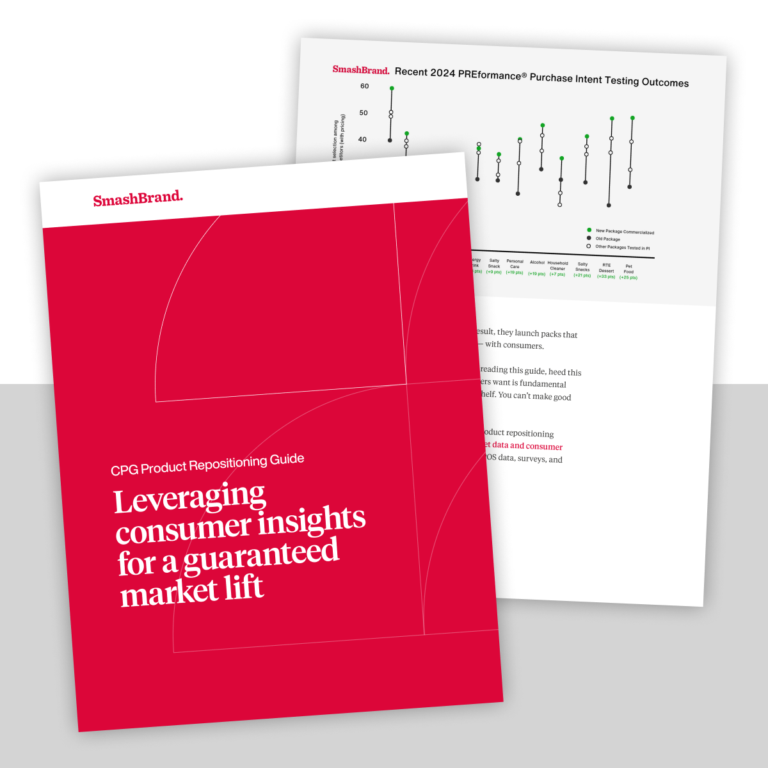
CPG product repositioning guide.
Explore the five undeniable signs your CPG product needs repositioning along with strategies for leveraging consumer insights for a guaranteed market lift.
Download Whitepaper About CPG product repositioning guide.