
 Overview
Selling in Costco is unlike any other retail environment.
You get one shot. One SKU. And you’re not just up against competitors on shelf. You’re being evaluated by a retailer that is known for creating better, cheaper versions of products, launching it under one of the most trusted private labels in America: Kirkland Signature.
Brands often treat Costco as just another volume play. But if you’re not managing price, quality, and service through the lens of how Costco thinks, you’re not just underperforming. You’re giving them a reason to replace you.

Inside the Kirkland signature playbook.
Kirkland Signature doesn’t exist in every category for a reason. Their entry is deliberate. They don’t launch SKUs unless a national brand fails to meet Costco’s value expectations. That failure typically falls into one or more of three buckets:
- Price: Your retail is unjustifiably high. In a category where pricing is inflated, Kirkland creates margin space by delivering similar value at a lower cost.
- Quality: Ingredient deck, taste, or performance underwhelms. Kirkland steps in with something better or at least better perceived by the consumer.
- Service: You are out of stock or underdelivering on availability. Costco’s members expect reliability. When you don’t have it, they make sure someone does.
This is the PQS framework. If you’re off balance in even one area, you’re on Costco’s radar as a candidate for replacement.

Costco buyer John Mullins explains the three triggers that prompt Kirkland Signature to enter a category. Price too high, quality too low, or brands chasing ACV over availability.
Red flags Costco watches for.
Brands often don’t realize they’ve tripped a wire until it’s too late. Here are some of the signals that should make you nervous:
- You can’t stay in stock. Especially dangerous if you’re early to a trend and creating new demand. Fail to deliver and a co-manufacturer may step in with a Kirkland SKU.
- You’re focused on ACV over depth. ACV, or All Commodity Volume, tells you how many retail doors you’re in. But Costco cares more about how well you serve their members. If you’re chasing distribution at the cost of reliability, expect scrutiny.
- You’re fueling category growth but underdelivering on experience. You may be driving interest in a space while creating an opening for someone else to outperform on flavor, texture, or packaging.
- You’re overpriced relative to your category. If your bone broth is $8 and a quality $4 option exists, expect trouble. You’ve invited value engineering and Kirkland excels at it.

Three ways to win in Costco.
Success in this channel comes down to strategy. And there are only three that matter:
1. Defensive: Protect Your Turf.
Use promotions strategically to prevent private label encroachment. TPRs (Total Price Reductions) and MVMs (Multi-Value Mailers) are designed to drive pantry loading and lock in high-volume shoppers. The goal is to take your best customers out of the market so Kirkland cannot take them from you.
2. Offensive: Launch With Precision.
Emerging brands can find fast traction if they get the mix right. Sampling, roadshows, and limited-time rotations drive trial and household penetration. But success here only comes if you are scalable, priced right, and exceed expectations from day one. Costco loves being first, but not if you flounder.
3. Collaborative: Partner Where It Matters.
In categories where private label struggles, such as beverage or alcohol, co-branded SKUs are viable. Kirkland x Deschutes worked because Deschutes brought award-winning taste and production capability, and Kirkland delivered reach and trust. This model doesn’t work in every category, but when it does, it can be a national-scale growth lever for regional “gem” brands.

What this means for your brand.
Costco isn’t looking for you to be perfect. But they are evaluating whether you’re the best possible option for their members in terms of value, quality, and availability. You may get on the shelf by being new and interesting. You stay on the shelf by being operationally excellent and consumer-aligned.
And if you’re not willing or able to adjust, they will find someone who is.
How We Help Brands Kirkland-Proof Their Strategy.
At SmashBrand, we’ve lived in this world. Our team includes former brand leaders from Kraft, PepsiCo, and Unilever who have fought and won in club stores before.
Our stage-gated process pressure-tests your packaging, pricing, and positioning in simulated club environments, identifying vulnerabilities before your Costco buyer does. We zero in on your purchase drivers and stress-test every variable that could trigger a Kirkland replacement.
Don’t Guess. Test.
In a store where shelf space is earned by performance,
packaging is not just your billboard.
It is your insurance policy.
Subscribe to
Nice Package.
SmashBrand’s Nice Package: Stay current with our latest insights
Free Resource.
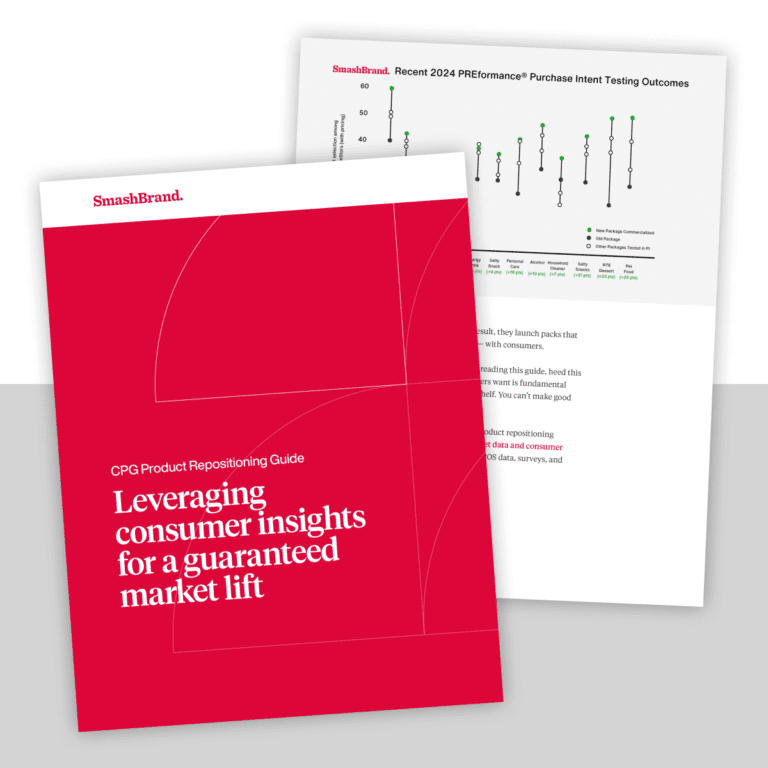
CPG product repositioning guide.
Explore the five undeniable signs your CPG product needs repositioning along with strategies for leveraging consumer insights for a guaranteed market lift.
Download Whitepaper About CPG product repositioning guide.