

Look in any clearance section or last-chance grocery store, and you will find a plethora of examples where design and/or copy missed the mark. Even the most amazing and innovative product will suffer a similar fate if the company was not deliberate about each element’s messaging before it reached store shelves.
For your product to avoid the discount or die path, a package design agency must purposefully design your product packaging, communicating the hidden purchase drivers most important to potential customers. Get this right and you will emerge ahead of the competition, quickly becoming a leader in your respective CPG category.
Identifying Category Purchase Drivers
While the framework for understanding what drives consumers may be similar, the actual purchase drivers differ from category to category. What drives someone to purchase candy will differ significantly from someone purchasing fruits and vegetables. Analyzing consumer behavior in a category is the first step to identifying the exposed purchase drivers for a product.
Finding the “assumed” exposed purchase drivers for a CPG product is easy. All you need is a quick google search, audit competing products packaging, or call to the grocery retailer asking questions about what is being purchased and why. All this tells you is what others think works for consumers. Without your own research and asking consumers, you are essentially rolling the dice as it pertains to your package marketing strategy.
Your product needs to stand out, but we don’t mean that in a way of having flashy packaging that jumps off the shelf. To correctly stand out you need to discover the hidden purchase drivers and convey those messages in a way that reaches and resonates with the buyer. Ensuring that your on-pack marketing brings attention to a need or desire that is common and agreeable with the consumer.
This isn’t always a straightforward task. Consider an industry such as bottled water where it is challenging to convey rational differentiation. Whether it is an emerging or established industry, a consumer packaged goods product must dig deep and formulate a product messaging plan that increases purchase intent.
| The Simplified Formula For Product Message Success |
|
Identifying Brand Purchase Drivers
An unfortunate truth is that much of CPG product messaging includes brand drivers that are valued by the company but don’t speak well to the consumer. A paraphrased mission statement of the CPG company placed on product packaging is holding important space that we can use for more important category and brand purchase drivers.
All brand drivers should be determined through research and tested customer data, matching the shopping experience of the consumer when exploring the products in a category. Through consumer insight, you will find out what brand elements speak to the shopper, both through initial brand awareness and brand recall.
What precedes this testing is a strategy that asks “what differentiates our brand from the competition and in what ways can we convey that on pack?” You then test this brand messaging to determine if what you believe to be true is actually a brand purchase driver that resonates with the customer.
Creating Differentiation Through a Hidden Brand Driver |
|
Toms Shoes took a seemingly ordinary product and created brand differentiation by making the consumer feel good about their purchase. This type of brand driver moved from rational benefits to emotional ones and is why their shoe brand exploded in sales. |
When Product Messaging Goes Wrong
Product packaging will always affect purchase intent. There is no situation in which your packaging doesn’t have either a positive or negative impact on the amount of market share owned in the consumer packaged goods category. CPG stores will not tolerate messaging gone wrong, as they have limited shelf space where sales per square foot are a pivotal metric. A new product is only a benefit to the retailer if it results in greater sales than the product it has replaced.
Missing Product Messages
For copy to be effective, it needs to get the point across in as few words as possible. An additional detriment to run-on messaging is that important conversations may not make it to the front of the label. It is important that each purchase driver delivers the message as concisely as possible.
This process is as much art as it is science, but is critically important to maximizing purchase intent. A CPG brand that is careful to consider the space a message takes. There should be as much white space as possible for additional purchase drivers or to simply let the label breathe.
Misunderstood Messaging
This topic may be better understood with an example.
Many CPG brands have adopted keto approved products as it is a trending choice for those who are hoping to follow a low-carbohydrate diet. While there has certainly seen an increase in consumer demand for keto products, clearance sections and discount grocery stores are littered with these types of products.
One reason is the disconnect between an acceptable amount of carbohydrates for the average keto diet and how a consumer feels about that quantity being on a product label. Technically, since less than 50 grams of carbohydrates per day is the average, you could have 45 grams on your label and be considered a “keto friendly” product. However, most keto shoppers are new and hold the ideology that all carbs will question the validity of a label if the panel shows even 1 gram of carbohydrate.
In this scenario, the brand that markets keto friendly on the front but displays 7 grams of carbs per serving will lose the misunderstood customer during the evaluation stage. This would have been a non-issue for these brands if they had tested their product packaging as a part of their CPG marketing strategy.
Assumed Purchase Drivers
Following the industry trends for package design is a good choice if you want to be exactly like your competition. If your primary intent is to be known as the cheaper option for the same quality, aligning with successful products may cause short-term success. However, what is to stop another brand from doing the same thing?
A better strategy is to come in unassuming and follow the “strong ties loosely held” philosophy. Be willing to let the data do the talking and base your marketing around the purchase drivers that prove to be successful in your product. While this is not common practice in the CPG industry, it is the only way to guarantee that you build upon brand loyalty or grab new market share for your new to market brand.
Creating Non-Verbal Drivers
We’ve spent a lot of time talking about words with impact, but non-verbal purchase drivers are equally important to the success of a product. Most times, it is the primary means of product differentiation for categories where rational differentiation is scarce. In any situation, we should test non-verbal drivers to ensure the message they insinuate meets the desires of the consumer.
Whereas many CPG companies leave non-verbal drivers up to subjective opinions, there are cases where on-shelf testing provided critical information about the product design. Here are two examples.
| TreeTop found that a white background led to a stronger perception that the product was a healthy choice, which is an important purchase driver for moms. | Tomato Love determined that a modern youthful design allowed them to speak to an audience among a sea of products unchanged in decades. |
How do you make your product packaging provide the correct perception yet stand out from the other products on the shelf?
Testing for Purchase Drivers
Any good marketing campaign will include A/B split testing, so why should package design be any different? With more eyeballs on your product in an aisle than on an ad, doing research and testing on the shelf should be the starting point. This is where the CPG marketing team should build its campaign from so that they can segment the messages to specific user audiences.
Package design testing clarifies what the consumer cares the most about. Once you identify these hot points, you can then bring them forward, making them the most memorable part of your design. Purchase drivers don’t have to be a mystery where you hope to identify the conversation going on in the customer’s mind.
The SmashBrand Approach For Identifying Purchase Drivers
We do the research to find out what matters. Once establishing what is important, we test your product by mimicking the retail environment, including product grouping, competitor placement, and shopper traffic. Through this testing, we come up with a needs analysis to find out what is missing. We continue to test based on the results of each iteration until reaching the point where we have the most effective purchase drivers for maximum purchase intent.
Discuss a project with our team to see how we can help your packaging perform at its highest potential.
Subscribe to
Nice Package.
SmashBrand’s Nice Package: Stay current with our latest insights
Free Resource.
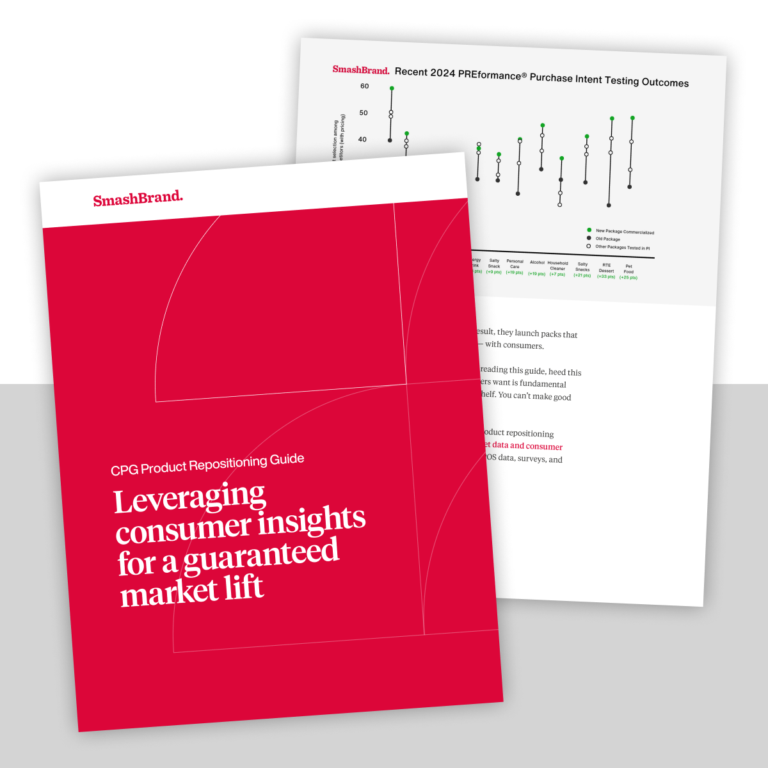
CPG product repositioning guide.
Explore the five undeniable signs your CPG product needs repositioning along with strategies for leveraging consumer insights for a guaranteed market lift.
Download Whitepaper About CPG product repositioning guide.