

How do you deal with someone who steals your brand identity? Roundhouse kick, uppercut, jab, right cross, left hook. But that’s only if the thief is standing right in front of you. If it is an anonymous little Internet weasel, you’ll need a different strategy.
Different-sized organizations handle brand identity theft in different ways. If you’re a huge, global brand, naturally, you have a firewall of attorneys on retainer that you refuse to feed and keep chained to mahogany conference tables until you catch a whiff of brand theft, at which time you release them to tear the financial entrails from the corpses of the offenders. But what do you do if you’re just a small fry?
Trademark Your Baby
Hopefully, you would have trademarked your brand, which will afford you some protection against unscrupulous thievery. Don’t be shy about trademarking multiple aspects of your brand and product line — hey, “jelly cheeseburgers” briefly seemed like a good idea to someone.
Diligence with regard to trademarking your brand is crucial. You can’t necessarily predict what element will catch on with the public over time — sometimes it turns out to be something that you didn’t necessarily coin, but which was undeniably the result of an association with your brand. For example, “tweet” wasn’t always owned by Twitter, but was originally trademarked by a developer in 2008. Moreover, it wasn’t something that Twitter’s marketing and development team created — it was born from somewhere within the legion of users. Twitter ultimately won the trademark in 2011, but it might slip from the social media giant’s fingers anyway, since it has entered into the lexicon as a verb. Brand terms and product names that enter into general use can fall into the public domain, and can furthermore occasionally exist long after the product has died.
Fun fact: Did you know that heroin was originally the trademarked name of a 19th century product that was used to wean drug addicts off of morphine? Well… it worked.
How to Identify Brand Theft
Google alert! (Or if one of your eagle-eyed social media interns spots the larceny.) While Google alert won’t be able to really help you in the case of logo design theft, if you receive an alert when your brand name or trademarked tag line has been hijacked and molested, you can address it quickly and with relatively little damage to your own bottom line.
Notice we recommended that you address the problem of your stolen brand identity quickly. Granted, this can be difficult to do when it’s your logo that’s been snatched (particularly if you haven’t registered or trademarked it), but failing to keep on top of your brand identifiers can lead to heaps ‘o legal trouble.
You can search the United States Patent and Trademark Office website to check if your logo has already been trademarked. Of course, it takes a bit of time to search. Every. Single. Variation. If you are concerned that your logo, or similar incarnations of the logo you designed, might be in use elsewhere but not trademarked, you can check out the site LogoLounge.com and search through the hundreds and thousands of existing logos they have in their database.
When a stolen brand logo… ain’t so bad!
Occasionally, a stolen (or inadvertently appropriated) logo design can bring design flaws to light. In the case of Airbnb and Automation Anywhere, not only was there a kind of completely accidental hijacking of Automation Anywhere’s original logo design, but the original design was [ahem] not great. (Many articles pointed out that it is quite similar to an immature rendering of a certain part of the anatomy.) The fact that the incident was spotted by several amused bloggers might have caused both organizations to reevaluate their logo choice, and both companies issued a statement that they were in the process of modifying their individual logos. That way, they both ended up with a better logo anyhow. Also, both companies got quite a bit of free publicity. So, all’s well that ends well.
But wait, what if my brand was already stolen and the thieves ran my brand identity completely into the ground, or worse, became successful beyond my wildest dreams and have infinitely superior lawyers? Fear not; we’ll address that in our next installment.
Subscribe to
Nice Package.
SmashBrand’s Nice Package: Stay current with our latest insights
Free Resource.
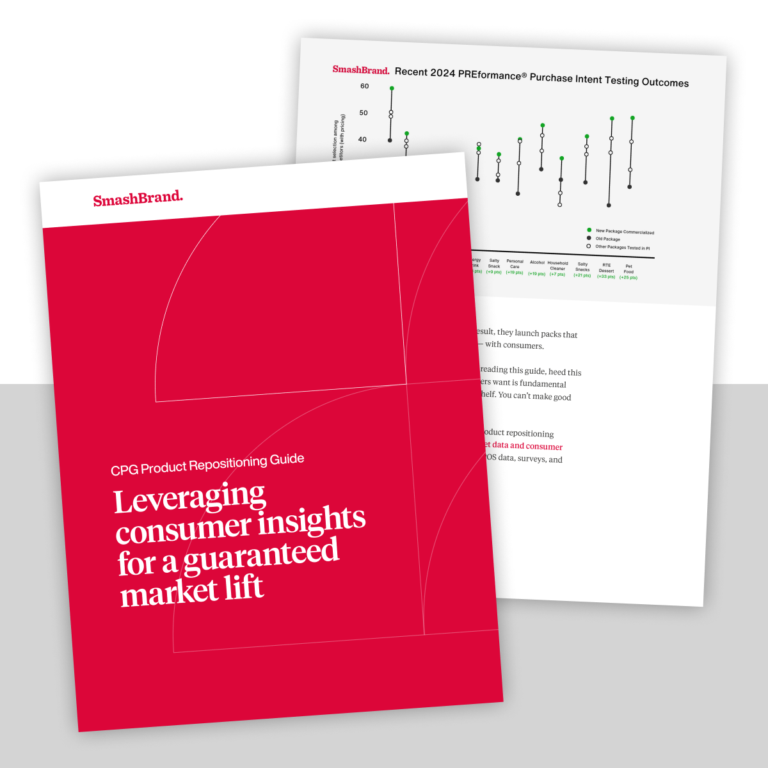
CPG product repositioning guide.
Explore the five undeniable signs your CPG product needs repositioning along with strategies for leveraging consumer insights for a guaranteed market lift.
Download Whitepaper About CPG product repositioning guide.