Brand development that increases sales velocity, guaranteed.

Front-of-pack messaging isn’t guesswork. It’s a formula.

Clarity wins at shelf. In this clip, we dive into the hierarchy of communication—what needs to be seen first, what can wait, and how we test to find the sequence that drives purchase.⁠

116 views
1 Likes
Dec 02, 2025

Description Description

Front-of-pack is not a checklist. It’s a system.

The hardest part of packaging strategy isn’t adding claims—it’s deciding what not to say. Space is limited, attention is limited, and the brain filters fast. What belongs on pack is a sequencing decision: first, help shoppers categorize. What is it? What does it do? If that’s unclear, nothing else matters.

From there, the hierarchy has to guide elimination. In a crowded aisle, consumers narrow options quickly. Your packaging must communicate differentiators in the right order—visually and verbally—so the brain can process without effort.

Too much information creates clutter. Too little creates confusion. The “magic recipe” is balancing visuals, copy, scale, and placement to match how real people judge in seconds.

That’s why testing matters. Because what feels important internally isn’t always what drives choice externally. Great packaging isn’t about cramming more onto the front. It’s about orchestrating emphasis so the decision feels instant—and obvious.

transcript Video Transcript
transcript-icon
  • 00:00:00 The reason we have so many testing is
  • 00:00:01 because it really does depend. But some
  • 00:00:03 broad strokes that maybe I can paint for
  • 00:00:05 everyone. This the hardest thing to get
  • 00:00:07 a sense of is like what actually belongs
  • 00:00:09 on the front of pack or on the packaging
  • 00:00:11 in general and because you really do
  • 00:00:12 have a limited space. It's not one thing
  • 00:00:14 but what it is is this like magic recipe
  • 00:00:16 that works. And so the nuance and trying
  • 00:00:19 to figure out that recipe that works for
  • 00:00:21 your brand has a few pieces like the
  • 00:00:23 amount of information you're trying to
  • 00:00:24 put forward can become
  • 00:00:26 counterproductive. that can get
  • 00:00:27 cluttered in the visuals there trying to
  • 00:00:29 understand what's communicated visually
  • 00:00:31 versus verbally. I think it all comes
  • 00:00:33 down to also is what is the need the
  • 00:00:35 consumer has or want and how does the
  • 00:00:37 product solve it and you kind of think
  • 00:00:39 about if I'm in a retail setting I have
  • 00:00:41 lots of choices and the human brain
  • 00:00:43 needs to kind of narrow down into
  • 00:00:46 process of elimination. So most
  • 00:00:48 important is you actually need to be
  • 00:00:49 properly categorized. Like I need to
  • 00:00:51 understand what this product is, what it
  • 00:00:52 does and then a lot of times there's so
  • 00:00:55 much subcategorization is just kind of
  • 00:00:57 getting down eliminated. So now I've got
  • 00:00:59 a workable set of product to choose from
  • 00:01:01 for the consumer and then conveying in
  • 00:01:03 the right order the differentiators and
  • 00:01:05 what you're doing. And again what I said
  • 00:01:07 is like is that visual is it verbal and
  • 00:01:09 a sizing of words and so a lot of the
  • 00:01:11 work that we do is understanding what
  • 00:01:14 belongs on front of pack and then also
  • 00:01:16 the hierarchy which visually translates
  • 00:01:18 into emphasis placement on pack and
  • 00:01:21 getting all the sequencing right to
  • 00:01:23 communicate because it doesn't really
  • 00:01:25 happen in like a lock step. It's like
  • 00:01:27 almost instantaneous. This is like
  • 00:01:28 judgment.

Subscribe to
Nice Package.

SmashBrand’s Nice Package: Stay current with our latest insights

Free Resource.
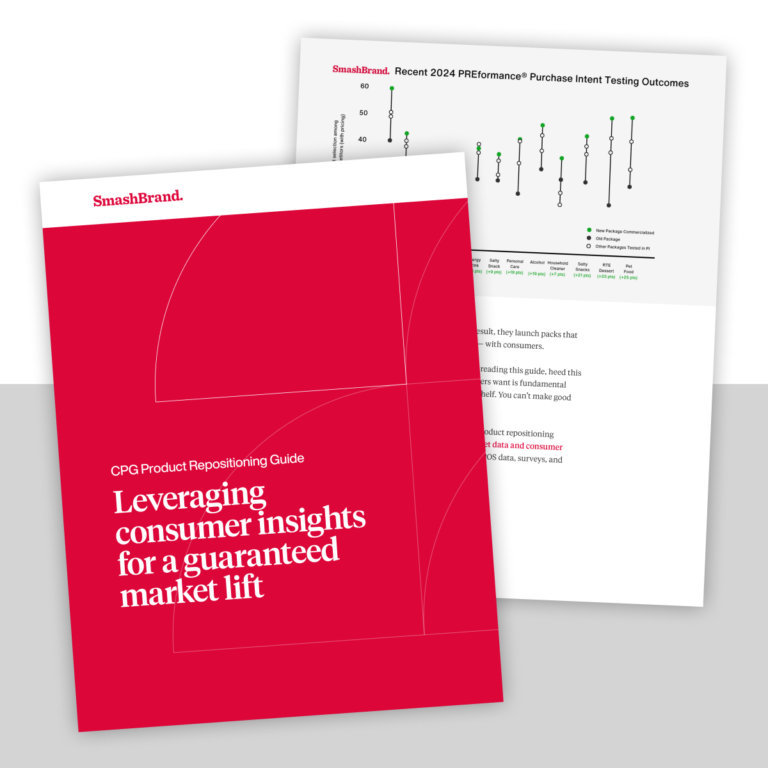
CPG product repositioning guide.

Explore the five undeniable signs your CPG product needs repositioning along with strategies for leveraging consumer insights for a guaranteed market lift.

Download Whitepaper About CPG product repositioning guide.

I wanted to buy this. The packaging talked me out of it.

The product checked every box: cheesecake, convenient portions, no cutting, and perfect for sharing. I was practically sold. Then the packaging made me question the quality, taste, and entire purchase. That’s how quickly design can destroy demand. So, how does promising packaging lose a ready buyer? Read on to find out.

352 views
5 Likes
Jun 12, 2026

What Garbage In Garbage Out Means for AI Packaging Concepts

AI can generate packaging concepts, but it can’t rescue a weak brief. Feed it generic assumptions, and you’ll get polished garbage faster. Feed it real consumer insights, decision drivers, and category intelligence, and everything changes. Before your next AI prompt, discover what separates pretty concepts from packaging that performs.

112 views
Sep 10, 2026

Why None of These Pet Wipe Brand Stands Out at Shelf

These pet wipe brands have a visibility problem, and better front panels won’t fix it. When packs sit low on the shelf with only their ends exposed, most branding disappears. That’s not a design problem; it’s a shopping-context problem. Want packaging that performs in the real world? Read on to see what’s missing.

129 views
1 Likes
Jun 03, 2026

Why Rao’s Soup Misses the Mark on This Packaging Design.

Rao’s is a pasta sauce powerhouse, but their soup packaging tells a different story.

490 views
5 Likes
Nov 26, 2025
1.
Follow Christy

Follow Christy for real-world shopper insights, brand wins, and weekly takes on what’s working in retail.

2.
Subscribe on YouTube

Subscribe on YouTube for daily brand insights, shelf-winning strategies, and weekly retail breakdowns.

19,627 views
27+ Videos
3.
Don’t miss our Newsletter

Sign up for NICE PACKAGE, our newsletter on packaging design, CPG strategies, and real-world brand performance.